// PROJECT SUMMARY
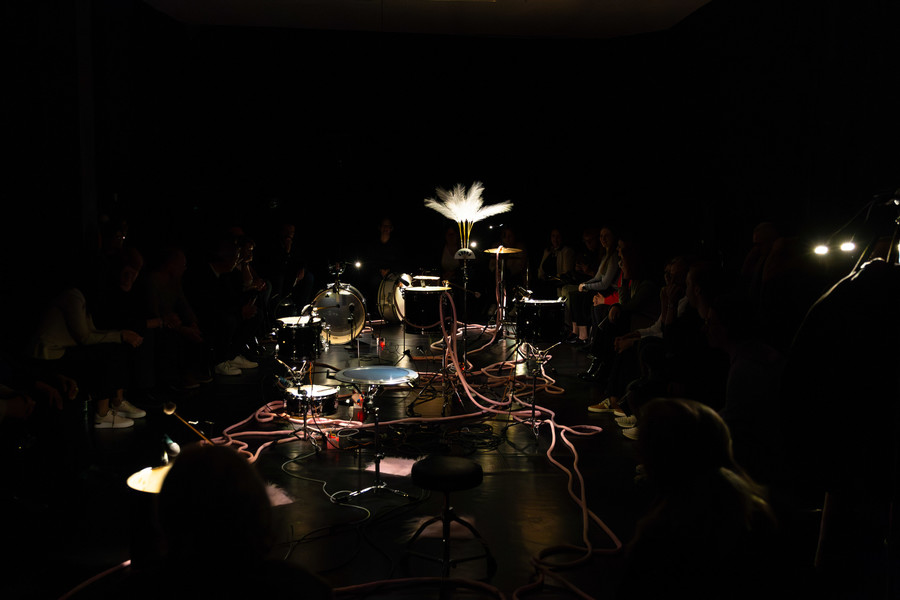
For the performing arts projects Pisma matere and Data Garden, JPM Systems developed custom robotic systems that became active elements of live artistic performances.
The installations included robotic devices capable of drumming and mechanisms that physically moved plants. But the biggest engineering challenge wasn't building the robots — it was developing technology for an artistic process in which the final requirements could not be defined in advance.
// THE PROBLEM
Traditional engineering projects usually begin with specifications: what the product should do, how it should behave and what requirements it must meet.
This project worked in exactly the opposite direction.
The artistic team knew the experience and emotions they wanted to create, but couldn't fully specify the technology before seeing it move, hearing it and interacting with it.
The artists needed the technology in order to develop the performance, while we needed their reaction to the technology in order to understand what to develop next.
This meant that a conventional specification → development → delivery process would not work.
// THE SOLUTION
We created an iterative development process in which engineering and artistic development happened simultaneously.
We first developed functional robotic concepts based on our interpretation of the artistic intent. These prototypes were introduced into rehearsals, where the artistic team could experiment with them and provide feedback.
That feedback became the specification for the next engineering iteration.
The process continued through repeated cycles of development → integration → artistic experimentation → feedback → development until the technology became part of the performance itself.
The resulting system combined custom mechanics, electronics, embedded firmware and central control software into a flexible robotics platform that could be manipulated during the creative process.
// OUR WORK
JPM Systems was responsible for:
- – Robotic system development
- – Custom mechanics and mechanisms
- – Custom electronics development
- – Embedded systems development
- – Firmware development
- – Motor and actuator control
- – Motion control
- – Algorithm development
- – Central control software
- – Communication between robotic devices
- – Interactive control architecture
- – Rapid prototyping
- – On-site development and integration
- – Iterative development with the artistic team
- – Technical support during rehearsals and production
// KEY CHALLENGES
Developing Without a Fixed Specification
The most important challenge was that the specification emerged through development.
The artistic team often needed to see and experience a movement before deciding whether it worked creatively. We therefore had to make engineering decisions independently, build functional solutions quickly and use the resulting prototypes as part of the creative conversation.
Requirements were not documents handed to the engineering team — they were discovered together through experimentation.
Translating Artistic Language into Engineering Logic
Feedback rarely arrived as engineering requirements. Instead, we received directions such as: Make it feel more organic. It looks too robotic. The movement should slowly build into a crescendo. It shouldn't behave exactly the same every time.
Our task was to translate these qualitative ideas into precise mathematical and software behavior.
Randomization, timing variations, acceleration profiles, movement envelopes and other firmware techniques were used to deliberately remove the predictable behavior normally associated with automated machines.
What began as an artistic description ultimately had to become deterministic code running motors and actuators.
Making Robots Behave Less Like Robots
Industrial automation normally aims for repeatability: perform exactly the same movement in exactly the same way every time.
For this project, that was often precisely what we needed to avoid.
We introduced controlled randomness and variation into the firmware so movements could feel more natural and less mechanical while still remaining within safe and useful boundaries.
Flexible Central Control
The performances were not simply pre-programmed sequences that played from beginning to end.
All robotic devices were connected to a central software control system that provided predefined movements and scenarios while still allowing the performance to be developed and controlled dynamically.
This gave the artistic team a vocabulary of robotic behaviors that could be combined and adjusted as the performance evolved.
An Immovable Deadline
Unlike many development projects, a live performance has a deadline that simply cannot move.
The date and time of the premiere were fixed. The audience would arrive and the technology had to work.
At the same time, development continued alongside rehearsals because the artistic team was still discovering how the robotic systems should behave. We had to balance experimentation with reliability, decide when concepts were mature enough to freeze, and continuously integrate changes without compromising the stability of the complete system.
// THE RESULT
The final robotic systems became more than technical equipment supporting the performance — they became part of its artistic language.
Custom mechanics, electronics, firmware and software allowed physical objects, percussion devices and plants to behave in ways that could be shaped together with the performers and artistic team.
More importantly, the project demonstrated a different form of custom product development: engineering for situations where the customer cannot provide a complete specification because the possibilities of the technology itself are part of what needs to be discovered.